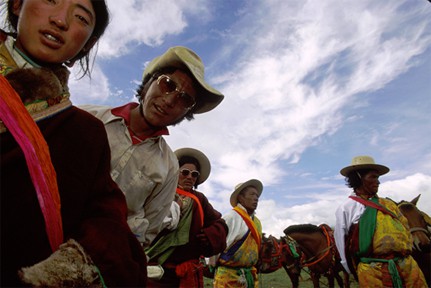
Over the course of forty years, working mostly alone and without institutional support, Sonam Zoksang has produced an enormous body of photographic work documenting the Tibetan world. The archive includes thousands of Kodachrome slides, color negatives, black-and-white film, and a more recent body of digital images. Most of the earlier material — the work from inside Tibet in the 1990s, the early Dalai Lama visits, the first decades of Tibetan community life in New York and New Jersey — exists only in its original analog form.
What is in the archive
The archive is organized, roughly, into six bodies of work:
- Photographs made inside Tibet over the course of multiple trips between 1993 and the present.
- Photographs of His Holiness the 14th Dalai Lama, made over the course of more than three decades accompanying Him on His teachings and public appearances in the United States and elsewhere.
- Photographs of the Tibetan refugee communities in India and Nepal, made during annual or semi-annual return visits over four decades.
- Photographs of the Tibetan diaspora in the United States — the Tibetan Association of New York and New Jersey, community gatherings, Losar celebrations, the second generation growing up — spanning the period from roughly 1987 to the present.
- Landscape photographs of the Tibetan plateau and the Himalayan foothills.
- A body of portrait work, some made as formal commissions and some made informally among the photographer's circle and extended community.
Exact counts are not yet possible — one of the purposes of the preservation project is to catalog the archive thoroughly for the first time. Preliminary estimates place the total at between three and five thousand discrete photographs, the great majority of them never published.
The preservation challenge
Most of the archive from the first twenty-five years of the photographer's practice exists on Kodachrome and Ektachrome 35mm transparencies, on color and black-and-white negative film, and on a smaller number of prints. These materials are not stable indefinitely. Kodachrome, prized for its stability relative to other color films, is nonetheless subject to gradual dye fading and to physical degradation from temperature, humidity, and handling. Color negative film fades faster. Black-and-white negatives are the most stable of the three, but are still vulnerable to mold, to silver mirroring, and to physical damage.
The archive is stored, currently, in cool, dry conditions in the photographer's home — which is far better than most private photographic archives of this period have received, but is not equivalent to archival-grade storage. More critically, the archive exists in a single location. A fire, a flood, or a single point of failure would end it.
The task of preservation, in practical terms, has three components:
1 · Digitization
Scanning every significant image at archival resolution (minimum 4000 dpi for 35mm originals, producing master TIFF files in the range of 100–200 megabytes per image). This must be done by a specialist vendor or by appropriately trained staff on a museum-quality scanner. Color calibration, handling protocols, and quality control matter enormously; rushed or low-quality scans permanently impair the record.
2 · Cataloging
Creating, for each image, a structured metadata record capturing place, date, subject, context, and publication history. This is the scholarly infrastructure that allows an archive to be used. The schema for this work already exists, modeled after standards used at the Library of Congress, the Peabody Museum, and institutional photography archives.
3 · Redundant storage
Holding master files in multiple physical and cloud locations, under a preservation-grade backup policy, with provisions for long-term institutional stewardship.
What preservation would enable
A digitized and cataloged archive makes possible what is not currently possible:
- Public scholarly access to a significant record of Tibetan history in the late twentieth and early twenty-first centuries.
- Exhibitions at institutional venues that require high-resolution reproductions and full metadata.
- A forthcoming monograph of selected work, planned as a companion to the archive.
- Institutional deposit for long-term stewardship, ensuring that the archive outlasts any individual's stewardship.
- Use of the photographs by the Tibetan community itself — the people depicted, their descendants, and the wider diaspora — as a resource for their own history.
Current status
A small portion of the archive has been digitized to date — roughly 150 to 200 images, scanned at varying quality and in varying formats over the years. These images form the basis of the site you are currently viewing. The remainder awaits systematic preservation.
The photographer holds all rights to all images in the archive. Publication and licensing inquiries are considered case by case and should be addressed through the Inquiries page.
A note on naming
The archive refers to images taken inside present-day Tibet as being in Tibet — without political qualifier. This is Zoksang's own usage, the usage of his community, and the usage of the institutions that have collected the work. བོད་ (Bhö) is the Tibetan word for the homeland and remains so regardless of borders drawn in the second half of the twentieth century. Where geographic precision is needed for cataloging, the schema records prefecture and present-day administrative boundaries; where memory and culture are concerned, the place is Tibet.
Supporting the project
This is a funding-seeking project. Institutional partnerships, grant opportunities, and scholarly collaborations are warmly welcomed.
Inquiries from foundations, institutional collecting organizations, universities, and press may be directed to the Inquiries page. We will respond personally to each message.