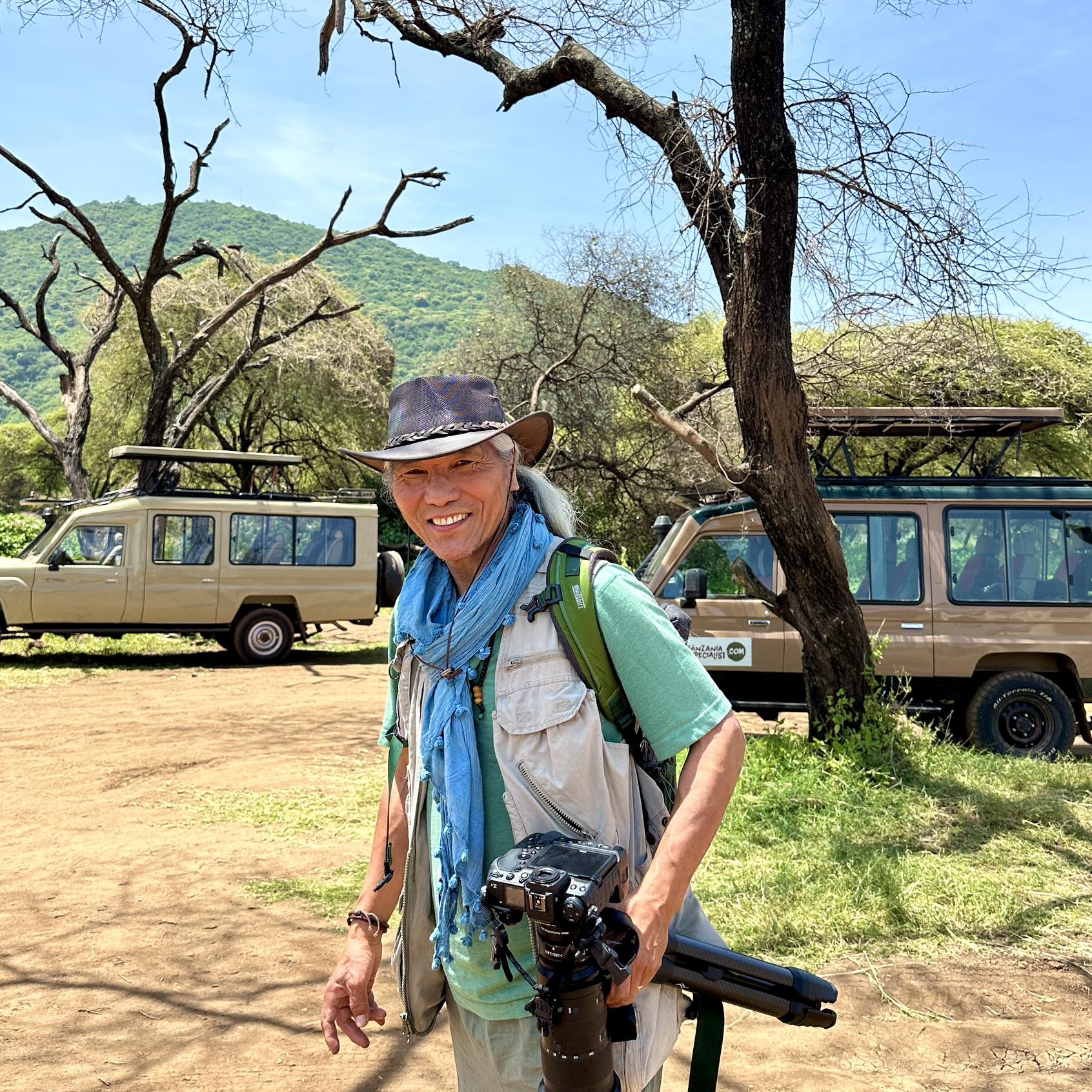
Sonam Zoksang was born in Kyirong, in southern Tibet, in 1960, the year after Chinese forces consolidated control over the country. His parents, among the first wave of some eighty thousand Tibetans who followed the fourteenth Dalai Lama into exile, carried him over the Himalayas into India when he was one month old. He grew up in Tibetan refugee schools in Kollegal, in the southern Indian state of Karnataka, and pursued a traditional Tibetan education, earning a degree in Buddhist Dialectics before turning, slowly and without formal instruction, toward photography.
In 1985 he moved to the United States at the invitation of an American he had met while studying Buddhism in Nepal. He settled first in New York City, where he worked as a bodyguard for His Holiness the Dalai Lama on His early visits — an honor he had held previously as a young man in India. When the United States State Department assumed protective duties in later years, the Office of Tibet invited Zoksang to continue accompanying His Holiness as photographer instead. He has held that informal role for more than three decades.
During those same years he taught himself his craft — reading in bookstores, subscribing to National Geographic, photographing first in Central Park and at small community gatherings, then with increasing seriousness across the Tibetan refugee communities of India and Nepal. In 1993, thirty-three years after his parents had carried him out, he returned to Tibet for the first time. The trip, and many that followed through the 1990s, produced what is now one of the most significant privately held photographic records of the homeland during the long, difficult decade that followed the brutal 1989 crackdowns in Lhasa. He photographed monks at Sera and Drepung, nomads in Amdo and Kham, landscapes across the high plateau, and the subtle changes — the new highways, the new signs, the new presences — that were reshaping a country his generation had been told to remember exactly as it was.
His photographs have been widely published and exhibited. A 1990s exhibition in a United States Congressional building was forced to close after less than a week, under political pressure from the Chinese embassy. Subsequent exhibitions have appeared at the Muhammad Ali Center in Louisville, the University of Arkansas Libraries alongside the 2011 visit of His Holiness, the Free Spirit Festival in McLeod Ganj, and in smaller regional venues in the Hudson Valley. His images have been published in Tibetan community newspapers, in the Central Tibetan Administration's official releases, in International Campaign for Tibet calendars, in Elizabeth Avedon's photography journal, and in dozens of books and magazine profiles of the Dalai Lama and the Tibetan cause. A 2015 segment for PBS's AHA! A House for Arts portrayed his work and his practice.
Beyond his photography, Zoksang is a founding figure in the Tibetan-American community: a former president of the Tibetan Association of New York and New Jersey, a longtime Board member of the U.S. Tibet Committee, and — with his wife, Kathryn Culley — the proprietor of Vision of Tibet, the Tibetan handicrafts shop he has run since 1987. First in Greenwich Village, then in the Hudson Valley, the shop today operates in two locations: Lake Placid in the Adirondacks, and New Paltz in the Hudson Valley.